Groundwater Survey & Water Detection in Bengaluru
A groundwater survey can help guide a borewell decision by considering conditions at a property. It is an assessment for planning, not a promise of water.
What can a groundwater survey tell you?
A groundwater survey can inform borewell planning by considering available information about the property and its conditions. It is guidance for a decision, not a promise of water or a specific yield; groundwater varies between sites and the drilling outcome remains uncertain.
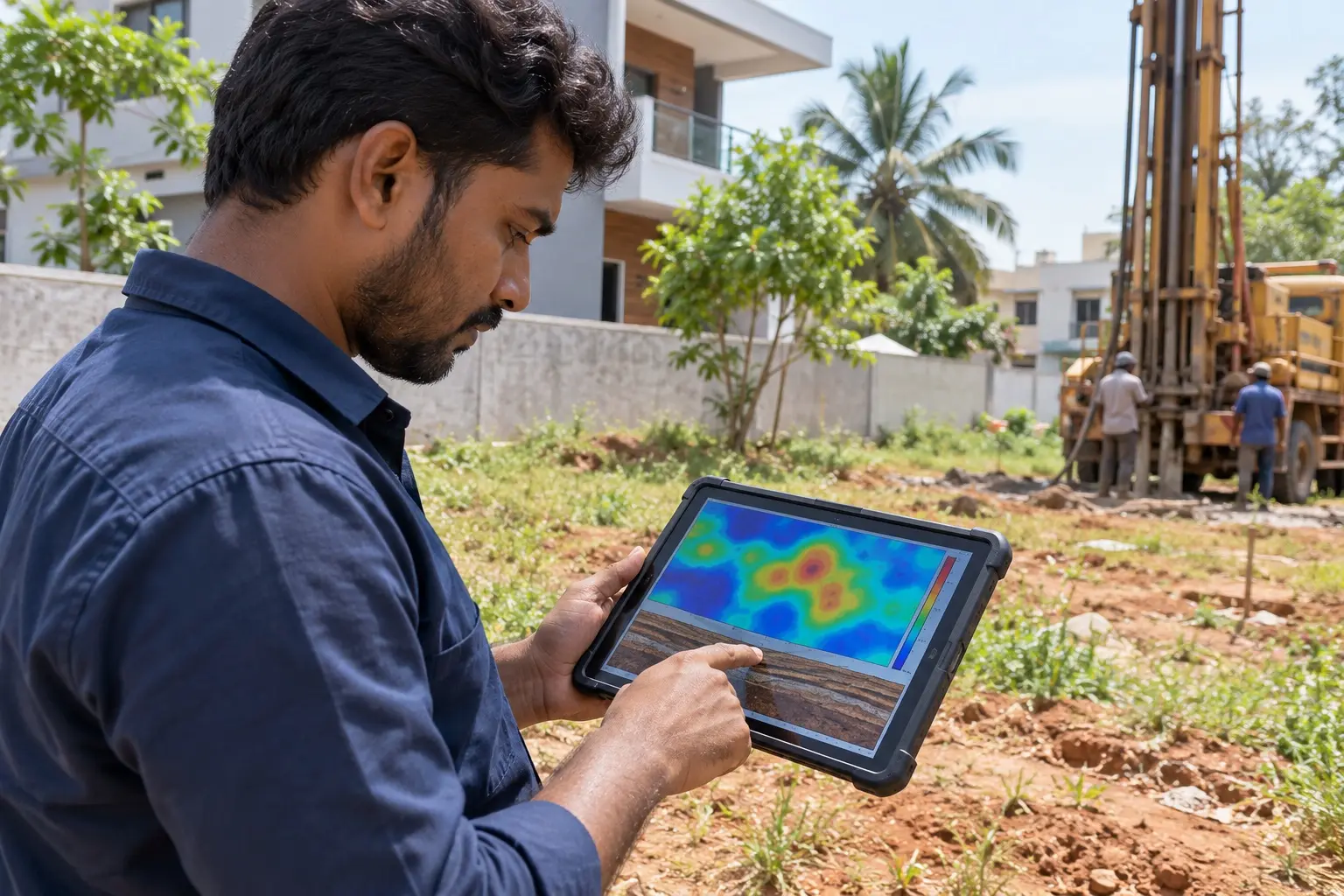
Before planning your site
- Provide the exact property location and any site plan available.
- Share known borewell or water history for the property.
- Use survey findings as one input to planning, alongside site conditions.
We discuss the site, available information and practical access before proposing a survey or drilling plan.
Groundwater conditions vary between properties, so results should be understood as guidance alongside local site conditions.
Water detection and borewell point checking
Borewell point checking, water detection and groundwater survey are terms customers use when deciding where to drill. Start by explaining whether you need a new drilling point, want advice about an existing borewell, or are investigating a change in water flow. These are different questions and may need different assessments.
Ask which survey method is proposed, what access it needs and what the findings can reasonably tell you. Confirm whether the scope includes an on-site discussion, a marked drilling point, written observations or a report. The method and deliverables should be agreed for your property; they are not assumed to be included in every visit.
What to share and how to use the findings
Bring a site plan or location pin, the intended water use and any available records of existing wells. Useful records include known depths, previous work and changes in flow. If you do not have records, say so rather than treating estimates as measured facts.
Ask the assessor to explain limitations and how the findings affect the proposed drilling point. A survey does not establish drinking-water safety, guarantee a particular depth or promise a sustained yield. Discuss water quality testing separately if the water is intended for drinking.
How the work proceeds
- Share the property details Send the exact location, any site plan, and what you know about nearby or previous borewells on the property.
- Survey the site The survey considers the conditions at the property to help decide whether and where drilling may be worth attempting.
- Review the findings Findings are discussed as one input to planning, alongside site access and the water requirement. They are not a promise of water or yield.
- Decide the next step If you choose to drill, the drilling point, rig and scope are planned from the survey discussion and the site conditions.
Common questions
Can a survey guarantee water?
No. A survey can inform planning, but groundwater conditions vary, even between nearby properties. We would never present detection as a guarantee.
What should I share before a borewell site visit?
Send your site location, property type, available access width and any existing water or borewell information. Site photos help us discuss suitable drilling machinery and the next step.
What affects the cost of drilling?
Depth, ground conditions, site access, casing and related work all affect the scope. A useful estimate starts with the particulars of your site.
Related service guidance
Last updated
Open daily, 9 am to 10 pm
Google Maps profile